
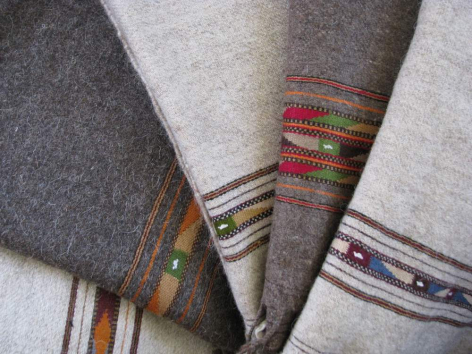
This patu is a heavy woollen plaid. This quality we have never seen in shops in Kabul. It comes directly from Pakistan.
This patu will for sure keep you warm during early spring, autumn and winter while sitting on your sofa, or outside... This woollen blanket is called patu in Afghanistan. The patu can be easily turned into a throw, plaid or baby blanket. The patu -plaid- is traditionally worn by men as a winter coat. In the summer one can use this plaid for picknicks.
The patu can be washed in the washing machine cold in the wool programme. The patu is made from pure wool (mainly sheep and goat wool). Gundara throws are available in a variety of shades, white, grey, brown...with varying colorful bordures.
You will be amazed how quickly this plaid warms you up! Give it a try!
These plaids were hand-woven in the Swat valley of Pakistan.
Please note that these plaids are not standardised products, colors, bordures and sizes may slightly vary betw. 240-265 cm by 125-140 cm. The side pattern (bordure) of the plaid may vary as well in width, shape and color, see the pictures in the different options below. The weight varies between 1200 and 1400 g, the darker patus are heavier than the lighter ones.
Brand
Hazer Gul is Providing Alternatives to Bonded Labor in the Weaving Sector
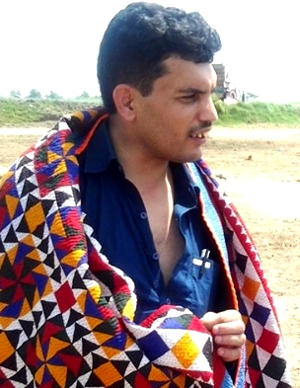
At the age of 16 he became a weaver. He worked over 9 hours per day for 8 years, but still, could never manage to make enough cash to feed his family. He witnessed that weavers were being exploited by middlemen and realized that the solution had to come from the affected communities themselves. The main problem is that weavers are paid with food, hence never able to save enough money to break out of exploitation. Illiteracy is high, and the lack of government services, such as public schooling, only exacerbates the problem. Somehow, Hazer Gul broke free from the hold of the middleman, attended school while working as a pump operator.... Looking for ways to improve the water supply to his village Hazer Gul created a community-based organization. The idea was to create awareness around problems in the community and to develop a better understanding of how issues at the household and community levels, such as large family sizes, increasing pollution, and illiteracy were all in one way or another linked to them being exploited weavers.
 Strong of his community work experience, Hazer Gul finally established the Islampur Cottage Industries Association (ICIA) in 2004 for all craft workers in Swat and Khyber Pakhtunkhwa provinces. Through this initiative Hazer Gul is eliminating the system of bonded labor in the cottage industry sector in parts of Pakistan. Starting in his home community in Swat, Hazer is establishing awareness of workers' rights, collective power and the need for education. He is integrating informal workers as key economic players into the economic cycle. Rather than demonizing middlemen in the value chain, Hazer has developed mutually beneficial solutions to abandon the traditionally exploitive system.
As a result, there are now 5,000 looms in Islampur owned by the community, as opposed to 1,200 in 1998.
Find out more here.